






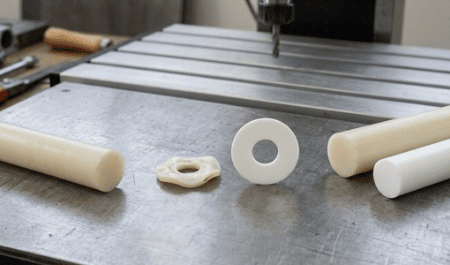
In the manufacturing of plastic parts for industrial machinery, choosing the right material is just as important as defining the dimensions of the component. Sometimes, an apparently simple part can present issues under demanding operating conditions. This is what happened with a batch of nylon washers that remained submerged in water at 95 ºC for approximately 15 minutes and, on certain occasions, showed signs of deformation. Given this situation, instead of simply remanufacturing the exact same part, a key question was raised: was nylon the most suitable material for this application?
In this case, the combination of elevated temperature, direct contact with water, and exposure time made it necessary to evaluate whether the material used was the most appropriate.
When a part suffers from deformation or premature wear, making another identical piece does not always solve the issue. Before selecting an alternative material, it is essential to understand how the component actually operates in practice. In this case, several factors were taken into account:
With this information, it was possible to assess whether the original material's properties met the demands of the application effectively.
One of the alternatives considered was replacing polyamide with PTFE (polytetrafluoroethylene). PTFE features extremely low water absorption and excellent behavior at elevated temperatures, alongside high chemical resistance. These characteristics make it particularly suitable for components operating in direct contact with hot water.
However, changing materials does not mean one is simply superior to another. PTFE has different mechanical properties compared to polyamide; therefore, it is necessary to verify that it responds correctly to the load, pressure, and assembly conditions of the specific application. Material selection must always consider the complete set of requirements for the component.
The goal is not to automatically replace one material with another, but to select the engineering plastic whose properties best align with the real working conditions of the component. And sometimes, this analysis can prevent the continued production of a part that will keep encountering the same issue.
At Induplast, we manufacture custom plastic parts for industrial machinery, working with various engineering plastics and assessing the specific needs of each application. Because when a part doesn't work as expected, the solution isn't always to simply make another one. Sometimes, the key lies in reviewing the material.
The problem: a nylon washer deforming in water at 95 ºC
The washers initially fulfilled their purpose, but periodic exposure to hot water occasionally caused deformations that could compromise the correct operation of the component. Polyamide (nylon) is an engineering plastic widely used in industrial applications due to its good mechanical properties and wear resistance. However, it also exhibits a characteristic that must be taken into account when operating in humid environments: it absorbs water, and this absorption can alter its properties and dimensions.In this case, the combination of elevated temperature, direct contact with water, and exposure time made it necessary to evaluate whether the material used was the most appropriate.
Analyze operating conditions before changing the material
When a part suffers from deformation or premature wear, making another identical piece does not always solve the issue. Before selecting an alternative material, it is essential to understand how the component actually operates in practice. In this case, several factors were taken into account:
- Water temperature: approximately 95 ºC.
- Immersion time: approximately 15 minutes.
- Direct contact with hot water.
- Dimensional requirements of the washer.
- Assembly and operational conditions.
With this information, it was possible to assess whether the original material's properties met the demands of the application effectively.
The alternative: replacing nylon with PTFE
One of the alternatives considered was replacing polyamide with PTFE (polytetrafluoroethylene). PTFE features extremely low water absorption and excellent behavior at elevated temperatures, alongside high chemical resistance. These characteristics make it particularly suitable for components operating in direct contact with hot water.However, changing materials does not mean one is simply superior to another. PTFE has different mechanical properties compared to polyamide; therefore, it is necessary to verify that it responds correctly to the load, pressure, and assembly conditions of the specific application. Material selection must always consider the complete set of requirements for the component.
Nylon or PTFE: the right material depends on the application
This case is a prime example of why there is no single engineering plastic that is universally better. Nylon can be an excellent choice for many industrial machinery parts. However, when factors such as hot water, high temperatures, or humidity exposure come into play, evaluating other options becomes necessary.The goal is not to automatically replace one material with another, but to select the engineering plastic whose properties best align with the real working conditions of the component. And sometimes, this analysis can prevent the continued production of a part that will keep encountering the same issue.
Machining of custom washers and plastic parts
Once the material is chosen, washers and other components can be manufactured through precision plastic machining, based on technical drawings, samples, or customer specifications.At Induplast, we manufacture custom plastic parts for industrial machinery, working with various engineering plastics and assessing the specific needs of each application. Because when a part doesn't work as expected, the solution isn't always to simply make another one. Sometimes, the key lies in reviewing the material.